I Stumbled upon this song today and am loving it.
It's good music like this that makes me feel that the human race ain't too bad after all.
The youtube comment: "This is what elevator music needs to sound like.." inspires me to want to design an elevator, and indeed a whole building, cool and funky enough to warrant it being played there.

Tuesday, March 22, 2011

Monday, March 14, 2011
Triple post:The problem with utopia; it still has people...

Perfection seeking Singapore.
After reading Monty Don’s description of Singapore "It is clean, comfortable, law-abiding and a paradigm of the modern, aspirational urban life. But from the moment that we arrived at the station I disliked almost everything about it.” I can relate. Whilst I wouldn't say I 'disliked almost every part of it' I have always felt a strange constrained vibe to Singapore and feel it also applies to my impression of Copenhagen. As much as I enjoyed my stay there, a six month study exchange, I was slightly depressed and disappointed by the city and on a wider sense Danish society. Perhaps not for the same exact reasons, but related none-the-less. The problem I felt with Copenhagen was that despite it being a rather enlightened society with a good social system, public services, a high standard of living and despite most people being quite intelligent and well educated there were still a lot of problems. People were still materialistic, although in a slightly different and more stylish way, people were still greedy, people still got drunk, people were still rude.
It made me realise that you cannot ever overcome all of society’s problems. This is because the problems with society stem from the inherent problems of human nature. It’s not that living in Copenhagen made me give up hope for a utopian society. It’s just that it made me realise how hard it would be to create this, and how far off we are from that today. (written 25/01/11)

Copenhagen Library: rational, smart, cool and stylish, but self-consciously so.

Income gaps (source:Bangkok Post)
After watching ‘The Shock Doctrine’ documentary I began thinking about the widening income gap, power and democracy. For the rich to actually get richer the majority still have to live in at least reasonable conditions. This is because if the majority suffers whilst only the very top live well, even if democracy has failed them, the power of the masses is such that once a tipping point is reached, such has been seen recently in North Africa, the corrupt system will be overthrown. I then did some research into world income gaps and, according to one source at least, found it interesting to see Denmark on top as the country with the lowest gap between richest and poorest. It is not a huge shock after living there and seeing the high level of public services; knowing that these result from the very high level of national income tax. What was surprising, however, was that once again I am presented with proof that Danish society is one of the most developed and enlightened in the world, and I don’t like it. As stated above the problems in Denmark might be very minor when compared to those faced by most other countries in the world, but this doesn’t make the Danish people themselves seem any nicer, happier or less flawed than anyone else.

Copenhagen: where 'fitting in' is part of being cool.
The best way to describe what I see as the problem with Danish culture is that it is very self-conscious. Of course it makes absolute sense that if you have all your basic needs met, and you are happy and intelligent you will put more effort into making sure that your style and your look is more precisely how you would like it to be, but the problem is that when it reaches the levels seen in Denmark, and Sweden and indeed most of Northern Europe, it becomes quite an obsession. A slightly arrogant and narcissistic obsession one might argue. The problem made evident by the self-conscious nature of Danish culture is that humans are incapable of being truly content. We are always wanting to be better, wanting others to be better for us and always looking for more. (written 14/3/11)

Perhaps this is simply my problem. Lisa:"Look I made a graph; I make a lot of graphs."
We are an inherently ambitious species and it is this ambition that has got us to where we are today. There is a downside to this ambition, however, and this is that we are a particularly ungrateful species, we are rarely satisfied with what we have and are almost always greedy for more. (written 25/01/2011)
Saturday, March 5, 2011
We enslave ourselves for freedom
Going home early on Saturday night so that I can get up early to work the next day I contemplate the situation.
The majority of my spending would probably relate to going out and enjoying myself. If I didn’t go out then I wouldn’t need to go to work.
So we bind ourselves to our employment for money.
And how do we spend our money? On enjoying ourselves and expressing our freedom.
The only way to have freedom in a capitalist society is to enslave yourself to your employer.
Herein lies the irony. We enslave ourselves for freedom.

A great image by Pawla Kuczynskiego
Tuesday, February 8, 2011
21st century architecture; why art thou so oblique?
Why are oblique forms so common in contemporary architecture?
Oblique forms dominate contemporary architecture of the 21st century just as basic geometry dominated design in the 80s. Slanted walls, shard-like windows and oblique facades can be found on buildings around the world in numbers never before seen. But why is this the current trend?

The Klein Bottle House, by McBride Charles Ryan
Is the oblique simply a manifestation of new drawing techniques? Is the ease in drawing oblique lines and forms on computer programs responsible for their presence in our cities? Are the rotate, taper, bend and skew tools really responsible for such a global trend? This may be part of it but I don’t think this is the main reason.

The Hedley Bull Centre, by Lyons
I believe the current trend is dictated mainly by a lack of understanding in design theory by most young designers today. It’s not that they don’t have anything to say I believe it’s that they are not inspired enough to see that they CAN say something about the world through their designs. Their understanding of design theory is shallow and thus so are their designs. What I believe is missing in design education today is design philosophy. The understanding that design can make a difference and the knowledge of how this can be done.
Oblique architecture to me represents the meek, wanky superficiality of society today. It represents a desire to stand out, to be seen and be stylish, but no desire to actually say something or have an opinion about the world. For too many people I think this is what life has become, it’s all business, all a show, nothing deep, nothing meaningful.
By why oblique?
I believe the current trend of the oblique stems from the popularity of deconstructivism in the 90s. Looking back, rather simplistically at late 20th Century design trends it can be said that after modernism had come in and banished all ornament Post-modernism then tried to bring it back. Post-modernism, whilst being quite an interesting style, lost favour as a style and a theory as it failed to really understand WHAT it was trying to say with ornament (in my opinion). Predominately ornament was used by the post-modernists in an ironic way. Irony being used here, as it normally is, to criticise something without actually putting forth a constructive alternative. As the post-modernist began to waiver in the early 90s the deconstructivists started to gain increasing attention. It is from deconstructivism, the works of Lieberskin, Hadid, Koolhaas and the like, that I believe that the current architectural style has developed.

The MAXXI National Museum, by Zaha Hadid
This ‘Oblique style’ can be seen as a stripped back version of deconstructivism. A minimalised deconstructivism if you will. Overall I do understand and see the usefulness of deconstructivism as a style and theory. At its strongest, when it makes us question the meanings we automatically give things, it can be very powerful, but at it’s weakest it’s just doing things differently simply to be different. It’s unfortunate that I think it is the latter where the current ‘oblique style’ has its roots and it is this lack of reason and lack of expression that I object to.

Nothing is safe from the cult of the Oblique.
The next trend? Well looking back at the design trends of the 20th century it can be seen that major trends tend to play off and rebel from what was before. People inherently find interest in what is new and exotic. If something opposes the status quo it is cool until it itself becomes the status quo. What I think, and hope, is that we’ll get bored of all this bland and meaningless play of obscure geometry and once again will want to see formal and materialistic complexity in our buildings. Perhaps, rather than hiding behind ironic criticism of the past or bland attempts to look sleek and sustainable, designers will start to actually have an agenda again and will be willing to boldly express this agenda through their designs. I also think that, as life becomes increasingly technologically orientated, the rough, textured and the imperfect will come to be more meaningful within our designs. I don’t believe that strict order will come back in just yet, but I think meaning has been overlooked for too long. Of course it is always hard to express ideas and an agenda in architecture since, unlike most other art forms, architecture must first and foremost be functional and meet the client’s requirements. But that doesn’t mean that architects are excused from even trying to express something through their designs. In short architects of today need to grow some gonads and actually say something with their designs. They need to really look at what their role is in our society and work at making the world a better place, not just a better looking one.
Tuesday, January 18, 2011
The Australian Ugliness. Robin Boyd
As nice as it is that Australia has an inherently mismatched and optimistic style, this does not mean that it produces inherently good buildings. Much of what is built, in fact, is utter crap.
A great book which candidly states this fact was written in 1960 by Robin Boyd. The Australian Ugliness.

Wherever you live there is something to learn about design in this book. Track it down if you can.
Here are some of my favorite quotes:
A great book which candidly states this fact was written in 1960 by Robin Boyd. The Australian Ugliness.

Wherever you live there is something to learn about design in this book. Track it down if you can.
Here are some of my favorite quotes:
“Australians now were more prepared even than Americans to allow anyone with something to sell to take control of the appearance of their country.” P46
“The worst anxiety is usually at the promotional level, but soon it transfers itself along the line through architect, industrial designer, muralist, interior decorator, typographer – everyone feeling his duty to create a feature, no one unanxious enough to make a plain statement of fact.” P68
“Surfers’ Paradise. It is a musical comedy of modern Australia come to life.” P85
“He does not care that the only thing of any meaning in art, the only creation, ultimately the only satisfaction in life, lies in understanding himself and making decisions accordingly.” P90
“And there is the basic objection to Featurism: a moral objection. No matter how successful it may be in pleasing the passing eye, no matter if it pleases to the extent of being judged beautiful, the entirely superficial, frivolous appeal of a Featurist object can never assist human awareness, wisdom and understanding. It is for this reason alone as degrading to human nature as it is to art.” P138-139
'Australian style' in architecture. A mismatch of styles.
What's the difference between Australia and yogurt?
One has culture.
This is a joke told to me by a cook in Denmark. I didn't laugh.
As much as Australia may be lacking in any particularly strong and unique cultural customs I believe it is a country with a rich cultural make up and even what could be called a unique style.
What I would describe as the ‘Australian style’ of architecture would most definitely consists of an amalgamation of other styles. Our society and culture consists of the adaption and amalgamation of a wide variety of ethnic groups. It is domestically orientated culture and most importantly it is a culture of optimism. I believe that Australian culture is inherently optimistic and our style matches this. We have a design philosophy of saying that everything is okay, everything’s good, life is good.
The first European buildings built in Australia were homesteads designed and built by early British settlers. These were traditionally Spartan buildings, due to material and labour restraints, designed in traditional Victorian styles. The mix of cultures, workmen and designers in Australia usually meant that these buildings were designed in a mismatched and episodic way. Booloominbah (1888) designed by John Horbury Hunt, although quite grand in nature, is a perfect example of an outcome of these homestead types built during the 19th Century. Its deep verandas, L-shaped plan and episodic mix of elements demonstrate the Australian style of mixing and reinterpreting English elements and styles.
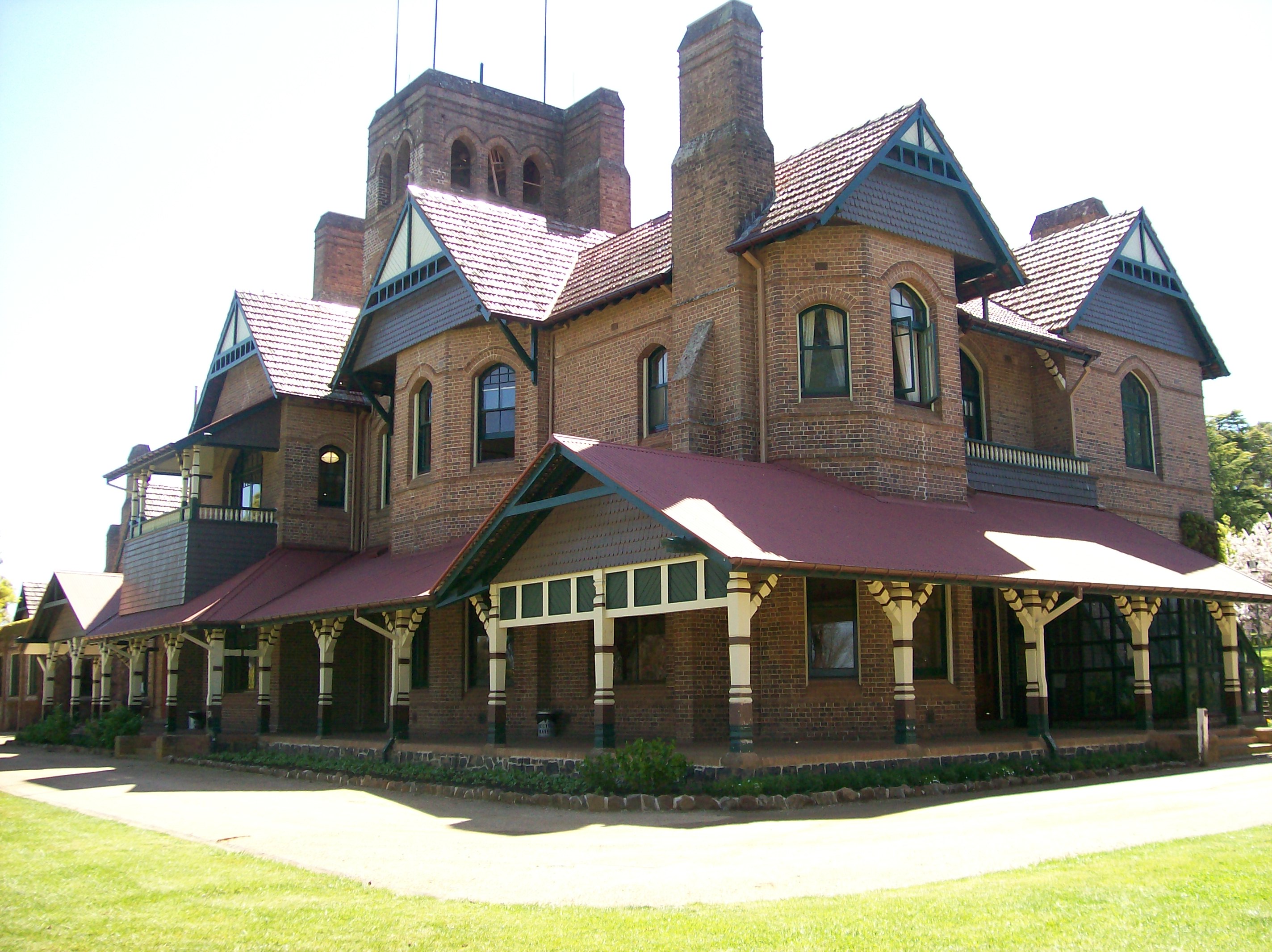
Booloominbah designed in 1888 by John Horbury Hunt.
What makes Australia’s current architectural trends distinctive are their basis in a country with a very domestically based cultural and architectural history. Early Australian architect’s amalgamation and reinterpretation of European styles within single buildings can be seen to have influenced many buildings of the early 20th century and this influence continues today. During the latter half of the 20th Century, as critics such as Robin Boyd began to criticise our obsession with an urban language of architecture, the prevalence of this language began to diminish, but the elemental nature of our “architecture of collision”, that is a form with expression of the different elements of a building as different pieces stuck together, still continues.
Australian culture and Australian style is a mismatched beast, one that brings together many elements, is positive and domestically orientated.
Wednesday, January 5, 2011
Life is simple. Why does everyone insist on making it complicated?
Why am I so sure that nature (natural materials, plants, connection with the environment (outside and as a whole)) must be present in all architecture? Because it serves as a very important reminder of the realities of our lives. Of what we are, and hopefully of what we’re doing with our lives. A lot can be said of watching a robin skip across a garden, or eating fruit that you’ve grown yourself.
It’s easy to forget about how simple our existence is when we are living in an overly complicated, overly ordered, man-made world full of overly complicated, overly ordered man-made buildings.
As our world becomes increasingly digitally orientated and increasingly filled with machines I believe that it’s becoming increasingly important for our buildings to tell us that life’s not that complicated.
Life is easy. Life is great. But only if we perceive it to be.

(Fairhaven beach, where the above thoughts came to me)
Subscribe to:
Posts (Atom)